

The Birth of Louis Armstrong's Hot Five in 7 Facts (+ 1 Video)
And a stellar tribute at NYC's most human listening spot

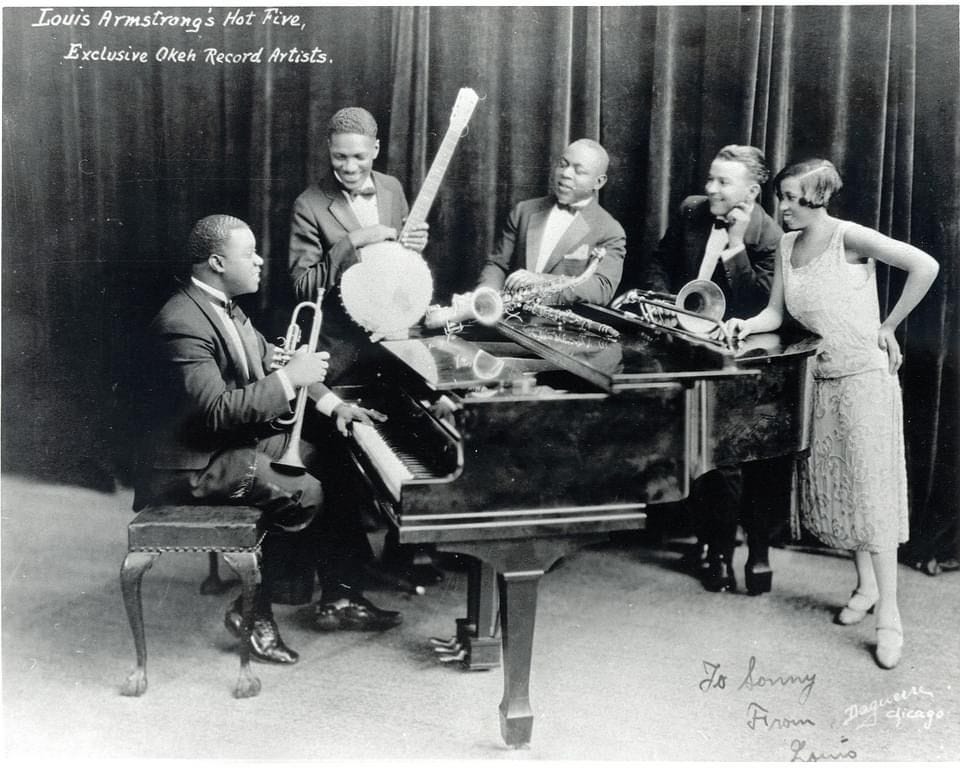
“I’m not one for superlatives, but Armstrong’s Hot Five recordings are the most influential records in Pop music. More influential than the Beatles or Michael Jackson put together.”
That’s multi-instrumentalist Nicholas Payton singing the praises of Louis Armstrong’s first recordings made with his Hot Five at OKeh in Chicago, whose centennial I was lucky to join recently at The Hot Club of NY, the 78 rpm listening club you’ve probably read about. Hot Club founder Matthew “Fat Cat” Rivera recounted in detail the history of that day, followed by a fantastic live re-creation of the November 12, 1925 recording session led by talented trumpet player/Armstrong scholar/bandmate of mine Andrew Stephens.
Seven things I learned that night — number three really floored me.
Louis’ wife/manager/piano player/career rainmaker Lil Hardin Armstrong set up the session with one specific goal in mind: In 1925, even though her husband was was a sought-after sideman and soloist for other bandleaders, the public didn’t know who he was. The Hot Five session would be the first recording to actually bear his name — and it changed the course of his career.
I knew the rough contours of the technology, but loved this granular detail: No microphones or electrical equipment here, the whole band played into a single large recording horn, which funneled sound mechanically to a cutting stylus. The stylus engraved the sound vibrations directly onto a rotating wax disc master, which was then used to make shellac 78 rpm records.
Louis did something quietly revolutionary in these sessions: He said the musicians’ names in the recording. Laying down gold solo after gold solo in sessions for other bandleaders, he himself had never received public credit, so he made a point to change that with his own outfit. “Whip that thing, Miss Lil!” he calls out to Lil Hardin Armstrong on piano; “Blow it, Kid Ory, blow it kid” to Kid Ory on trombone. Listeners would get to know the players by name, the “we’re all making this up together” vibe would come across for those who couldn’t see the band live, and it showed Louis off as a generous bandleader — he operated on the “to get credit, give it away” model, which comes through in all he does.
Louis and Lil each brought an original composition to the date and sold both of them to the record company for a $50 flat fee, forgoing any future royalties. (Deep breaths. So many deep breaths.)
Johnny Dodds on clarinet couldn’t play without tapping his foot, which was making a crazy racket on the recording. They stuck a pillow under his foot to dampen the sound.
At the end of the session, the record company rep, E.A. Hearn, demanded they record a blues, since those had done well for OKeh. Allegedly Armstrong wasn’t thrilled, but he and the band made up “Gut Bucket Blues” on the spot, naming it after the bucket fishmongers rake guts into. It became the first single.
The title “Yes, I’m in the Barrel” is a nod to losing all of one’s clothes to gambling and having to wear a barrel home. Here’s the opening of this total banger from the Hot Club of NY’s Hot Five Centennial jam:
In a fabulous post-script, pianist Charles Chen recently used the powers of AI for good: You could never really hear Lil Hardin’s piano on these recordings, which only stoked her reputation as a middling pianist and the Hot Five’s weakest link. Charles managed to isolate her piano part and bump it up in the mix so you can really hear it — and lo and behold, Lil is killing it! She’s holding it all down:
On Lil: A lovely way to begin acquainting yourself with her work and legacy is the 2012 documentary The Girls in the Band, about the untold stories and groundbreaking journeys of female jazz instrumentalists from the 1930s on, streaming for free on Tubi.