

My Best $4 Vinyl Purchase of 2025
...and 9 other things about music worth sharing right now


[Backstage at Tokyo’s Cotton Club on Christmas Eve]
Happy new year! It’s 2026! What could possibly go wrong?!
I spent Christmas Day in Tokyo perusing the second-hand vinyl bins at Tower Records — an actual brick-and-mortar Tower, with astonishing displays handmade by employees. (If you haven’t seen the excellent documentary about the fall of this former music giant, All Things Must Pass, you can stream it for free on YouTube.) My band played six shows at Tokyo’s Cotton Club, and I learned that Christmas in Japan is a bit like Valentine’s Day: It’s a big, romantic affair, and then on the 25th you eat Kentucky Fried Chicken (which began as a marketing ploy, like Santa Claus and Coca-Cola.)
I bought only one record that day: 1955’s Clifford Brown With Strings, which I’d never heard and is easily the best $4 I spent in 2025. Arrangements by Neal Hefti. I’ll be geeking out more deeply about this one at some point, but for now, go listen — here’s the whole record on YouTube and Spotify (“Willow Weep for Me” gets me). First spin of my Japanese copy, below. You can judge my low-rent record player, but this puppy lives in the kitchen and could get drop-kicked by my 3-year-old at any time, so.
“Dream a Little Dream of Me,” “I’ve Got Rhythm,” and “Georgia on My Mind” are just three classics that landed in the public domain on January 1 (a.k.a. Public Domain Day). Which means you can record a cover without paying royalties to the composers or lyricists, but more mind-bendingly, that you could, say, turn one into a whole new (copyrightable) song. That’s right: If you take the melody of Hoagy Carmichael’s “Georgia on My Mind” and write a new song with it adding “sufficient new and original authorship” (define “sufficient”), you could copyright it. I have no plans to do so, but I find this fascinating. P.S. “Georgia” is my parents’ “song” — specifically, this 1960 recording by Ray Charles.
Some things just take the time they take: Over a painstaking six months, Mattias Krantz taught an octopus to play the piano.
“I felt that dancing and flying [airplanes] were two ways of getting to the same state. I think that anything that you do with every particle of yourself can be wonderful and can make you forget the world. It’s magic.” I got so much joy and inspiration from this interview with WWII Air Force aviator-turned-Broadway dancer Dancer Stuart Hodes on what dancing does for him. It captures better than I ever could how I feel about playing music with others. Stuart only stopped dancing at the age of 92. (Related: Dick Van Dyke singing “When You’re Smiling” at his recent 100th birthday party, accompanied by Jon Batiste. I’d kill for pitch like that at half his age.)
“Each song and each act of creativity, indeed, is an act of defiance in a world that often feels determined to destroy itself…. We have a choice: To be on the side of creation, or surrender to the powers that destroy.” That’s Wilco frontman Jeff Tweedy in the foreword to his book How to Write One Song, which I’ve been devouring:
No one writes “songs” plural. They write one song, and then another […] to disappear—to watch your concept of time evaporate, to live at least once inside a moment where you aren’t “trying” to do anything or be anything anymore. To spend time in a place where you just are. […] That’s something that doesn’t happen through “songs” plural. It only happens when you’ve lost yourself in the process of making one song.
I’ve thought a lot about how it’s almost impossible, in life, in the world, to ever just BE, but Tweedy nails here something I didn’t even realize I loved about writing songs. I completely forget myself and live inside the song for a bit.
The wild, weird story of how a late-career Ella Fitzgerald had to break a glass in her audition to become the face of Memorex cassettes.
Life lately: I played with the stunning Seattle Symphony on NYE, I shared why Rob Reiner is the reason I moved to New York, and I kicked off co-hosting the Noir City film festival with TCM’s Eddie Muller.
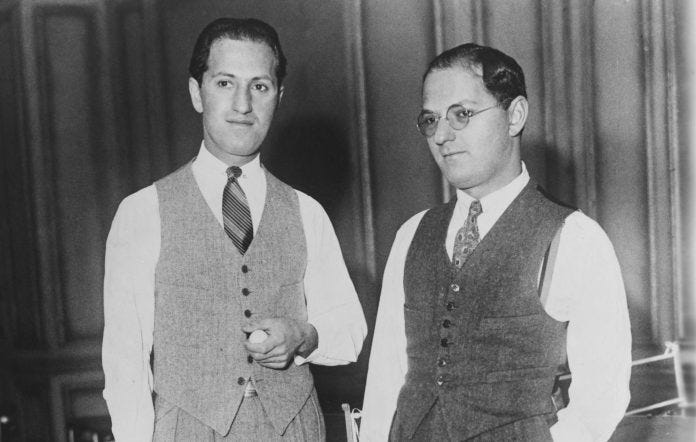
Finally, a context-free photo: George and Ira Gershwin take a break from playing ping pong, circa 1925.
Lead photo: Backstage at Tokyo’s Cotton Club on Christmas Eve with the band: Jen Hodge, David Berger, Todd Londagin, J. Walter Hawkes, Matt Ray