


In 1958 Ellington met Queen Elizabeth II in Yorkshire, England while appearing at the Leeds Music Festival. He was presented to her at a civic reception and — as he later told it — they lingered in conversation at the end of the receiving line, trading light banter and what he himself characterized as polite “flirtation.”
“She asked me, ‘When was your first time in England?’” recalled Ellington in 1961. “‘Oh,’ I said, ‘oh, my first time in England was in 1933, way before you were born.’ She gave me a real American look; very cool, man, which I thought was too much.” He also recalls what planted the seeds of the suite: “I told her that she was so inspiring and that something musical would come out of it. She said she would be listening, so I wrote an album for her.”
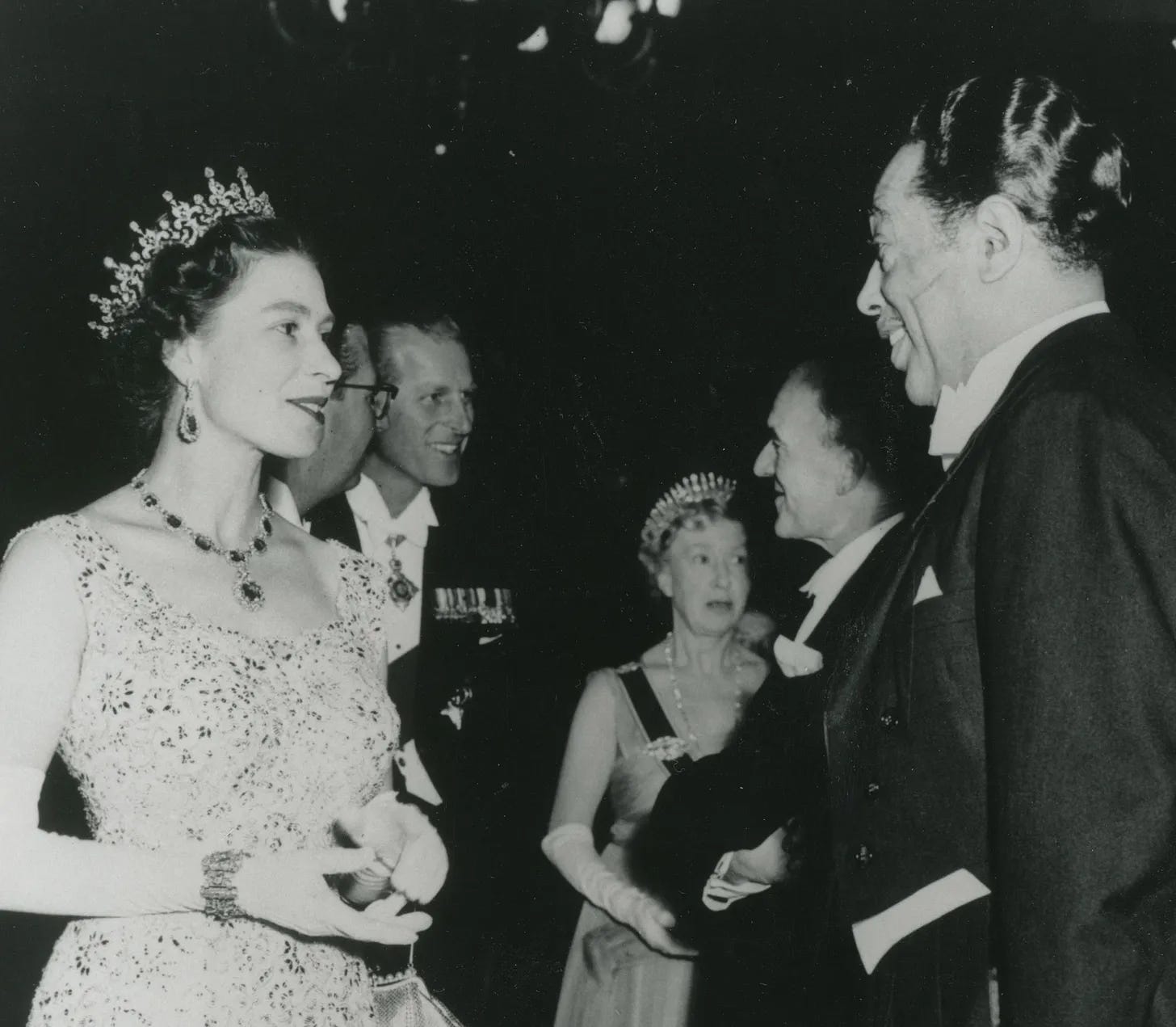
And so, shortly after that meeting—some accounts say that very night—Ellington sketched a multi‑movement work that became The Queen’s Suite, later developed in collaboration with Billy Strayhorn. The suite is made up of six impressionistic movements mostly inspired by natural scenes Ellington had encountered in his travels: a mockingbird’s call in Florida (“Sunset and the Mocking Bird”), lightning bugs and bullfrogs along the Ohio River (“Lightning Bugs and Frogs,” composed by Strayhorn from Ellington’s description), the northern lights on a lonely Canadian road, and other nature‑tinged images, all very elegant and pastoral.
But then, there’s “The Single Petal of a Rose,” largely solo piano, with, on a very spare rubato bass, Jimmy Woode (he of the classic solo on Ellington’s “Satin Doll”). If you don’t know it, may I suggest you go find it immediately and listen without eliminate all distractions while
Have you ever felt more like you were eavesdropping on someone’s most private thoughts? If there’s a piece of music that more accurately captures the feeling of just having met someone who’s sparked something in you—and perhaps, in that moment, sensing that you sparked something in them—I don’t know it. It feels incredibly intimate. And if I had to guess where its wistfulness comes from, I might suggest it’s the knowledge that—given time and space and royal titles and other very obvious (for 1958) obstacles—they likely wouldn’t share a private moment again.
Ellington recorded the suite with his orchestra in 1959 and had a single master pressing manufactured as a special gold disc, which he sent in secrecy to Buckingham Palace.
And then? He vaulted it, effectively keeping it secret, wanting it to remain a private exchange between the two of them. Ellington reimbursed his label, Columbia, some $2,500 in production costs, to make sure he owned the master tapes (and thus no other copies could be printed). It was released by Norman Granz (and won a Grammy) in 1976, after Ellington’s death.
Listen to “The Single Petal of a Rose” below.


