


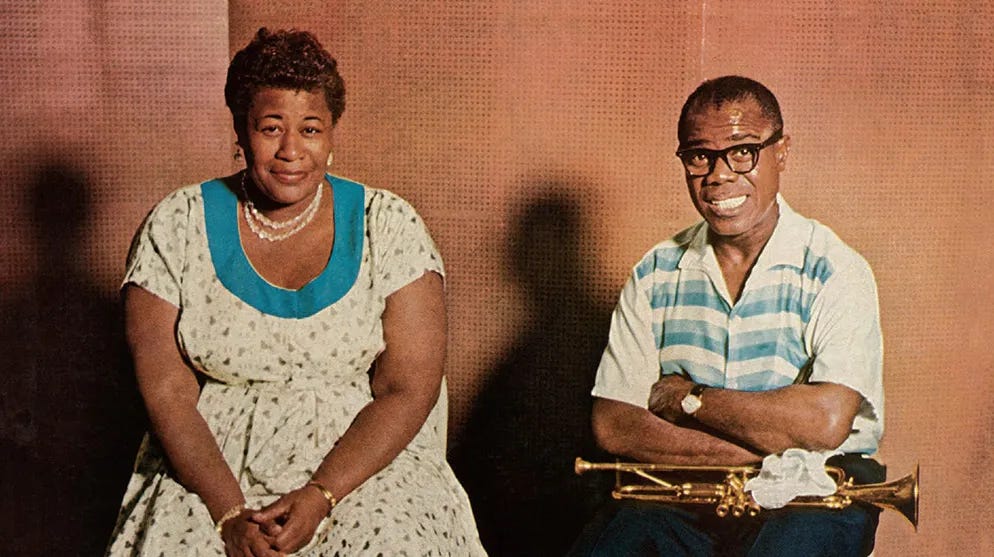
In 1956, jazz might have decidedly begun moving on from the form and feel that defined Ella and Louis’ early careers — it was arguably the year Miles Davis became a thing and Chet Baker’s work helped define a West Coast sound, all while the airwaves thrummed with Elvis Presley’s debut record.
But Norman Granz, a jazz impresario known for his Jazz at the Philharmonic concerts and civil rights advocacy, managed Ella Fitzgerald and was aiming to elevate her above jazz circles into mainstream popularity. After powerlaunching his Verve label in spring 1956 with Ella Fitzgerald Sings the Cole Porter Songbook (which sold 100,000 copies in its first month of release), he paired her with Louis Armstrong to create a duet album of American standards. Granz chose slow-to-moderate tempo ballads but apparently deferred to Armstrong for final song choices and keys.
The album was recorded in a single day on August 16, 1956, at Capitol Studios in Hollywood, right after a Hollywood Bowl concert. Backed by the absolute dream team that was the Oscar Peterson Quartet (Peterson on piano, Ray Brown on bass, Herb Ellis on guitar, Buddy Rich on drums), they cut 11 tracks including "Cheek to Cheek," "They Can't Take That Away from Me," and "Gee, Baby, Ain't I Good to You." The result is magic.
For further reading on how Norman Granz fought racial prejudice in jazz, I recommend Alexandra Piper’s piece Norman Granz: Revolutionizing jazz for social justice (Smithsonian, National Museum of American History).
Video transcript:
The next time you think to yourself, oh man, I have such a busy week and I have a big presentation to give and I have no time to prepare for it, I want you to consider this. Today in 1956, Ella Fitzgerald and Louis Armstrong went into the studio with zero rehearsal, zero preparation, and recorded Ella and Louis, basically defining the genre of the jazz ballad duet.
They didn’t know what songs they were going to be doing ahead of time. Norman Granz, who had started Verve Records, had the idea to put them together. So he booked studio time for the morning after a huge concert at the Hollywood Bowl with Art Tatum, and Oscar Peterson, and all these big names, that would eventually become the album Live at the Hollywood Bowl.
He booked studio time for the next morning so that Ella and Louis could go in and record these songs. They set all of the songs in Louis’ key to make it easier. So Ella adjusted to that and they did everything in one, all 11 songs in one session at the then-new Capitol Studios. And the result is basically, you know, one of the greatest records of all time: Moonlight in Vermont, Cheek to Cheek, Can’t We be Friends, They Can’t Take That Away From Me. Just classics. Classics. So the next time you’re thinking you have a busy week and you maybe don’t have time to pull it together to do your best work, you probably have more… you probably have more time than you think.


